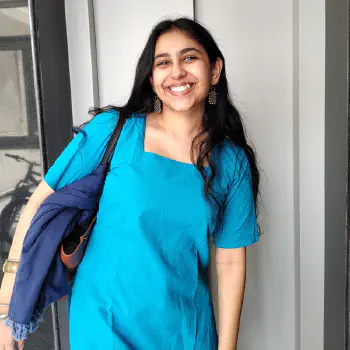
When I went through my own struggles with mental health and witnessed the same in people around, it became a driving force to starting my journey in this field.
I consider it a privilege to be such a close part of someone’s journey and to create, mutually, a space that can be called safe. I think we often assume that its only the therapist who impacts the client’s life, but in reality there is so much that changes within me in my journey with my clients.
To get an idea of the way I work, to clarify any queries that they have and experience some level of comfort with me. I want my clients to show up as they are and know that all the range of emotions that they are experiencing in the first session is understandable and that they are not alone in this. I like to demystify the process as much as possible.
I check in with the clients about the direction in which they want to head so that we can set goals together. I let them know that they can bring up concerns and give feedback at any point. I ensure that when I say something, it’s not an expert opinion, and it’s their right to disagree. Even when strategies are suggested, I ask if they have tried or if they want to try, I don’t assume that just because it has worked for others it will work for them.
Clients have been living and dealing with their concerns in ways that they know. Before I introduce strategies, they have taught me to curiously explore what they have already been doing and then to build on/add to it.
I don’t just work with clients at an individual level but view the impact of external systems on mental health. While skills and theories are important, I place a lot more importance on my personhood in sessions that help build a trusting relationship. Clients’ lived experiences are given the utmost importance.
I enjoy binging on reality shows, painting, dancing, park walks and spending time with my fellow humans.
I don’t believe that one size fits all and hence the choice of therapeutic approaches is made based on the needs of each client. Having said that, I incline more towards narrative therapy and incorporate an intersectional, queer affirmative, and trauma-informed lens. These imply that in therapy we view the problem as the problem and consider the impact of different psycho-social-political systems on mental health.
I do not go in with an assumption of gender, pronouns, and sexual orientation in my sessions. I execute this through the language I use. The intake forms have spaces for each of these information that clients can fill in or choose not to. I seek supervision and engage in self-work to keep my biases in check. The space explores the experience of queer and trans folx within the context of the systems we live in.
But what are these "throw-ins," these elusive, "off the record" extras? They exist outside of formal theory, they are not written about, they are not explicitly taught. Therapists are often unaware of them; yet every therapist knows that he or she cannot explain why many patients improve. The critical ingredients are hard to describe, even harder to define.
Hit the button below, ask questions, clear doubts or anything else you might need to clarify. Youβve got this! π
Profile details
Learn about their approach, specialties, and how they can support your mental health journey.
Take the first step by reaching out to start a conversation about your needs.
Determine if this is the right match for you and plan your journey forward.
Not finding what you're looking for?
View other profilesWhile we carefully curate our listings, we encourage you to make your own informed decisions. Take time to research, ask questions, verify credentials and choose what feels right for you. Your comfort and safety is top priority.
We've developed a curation process over 7+ years, which allows us to carefully curate each inclusive and affirming mental health provider listed on our platform.
We have come a long way since we started in 2018, and have been adapting our curation process every day. From the time a therapist or support group reaches out to us, it takes about 1 - 2 months to complete the process.
We launched TheMindClan.com because we know firsthand how challenging it can be to find support for ourselves and our loved ones. We know that experiences of neurodivergence (like dyslexia, ADHD, autism, etc), or being from a marginalized community (LGBTQIA+, etc), can make it especially challenging to find support.
We understand the overwhelming feeling of scrolling through endless lists, wondering whom to trust, and not knowing what to expect.
If you appreciate our mission of making mental health care accessible and inclusive, and would love to bring this to your organization or collaborate with us, we'd be delighted to hear from you!