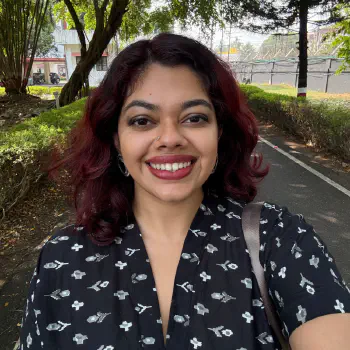
Growing up I was always an emotionally sensitive kid who felt her emotions very deeply and often found it overwhelming to navigate them. Looking back, I definitely would have benefitted from seeing an MHP. However, this also helped me understand myself and others very differently from those around me. It helped me tune into my inner world with ease and also helped me connect with people very easily. I was also very fascinated by stories of others’ lives and always found myself curious to know more about people. This inclination made me pursue journalism, psychology and literature with hopes of building a career as a journalist focusing on people’s lives and their stories. But my stint in that space did not satisfy me and I picked up master’s in clinical psychology which turned out to be a great fit for my emotional sensitivity, and curiosity. This eventually landed me a role as a counsellor which I deeply cherish and enjoy.
Being part of my clients inner and outer world and the stories they hold close to them is very exciting for me. The trust we build together over months and years is a very valuable experience and I feel privileged to witness my clients journeys. The different possibilities that open up over the course of our journey is also very exciting for me as a therapist and I even take this hope back with me to my personal life.
My first session is a consultation space which provides the client with a sneak peek into what our journey would look like if they choose to continue working with me. I have a couple of enquiry questions to help me get to know the client better and I would hope for the client to go back feeling safe, acknowledged and heard.
Starting therapy can often be a very scary step to take. I would encourage my clients to ask as many questions as they wish to in this space. Therapy is a way of showing up for yourself and offering yourself the care and concern that can be missing in our lives. You do not have to have a diagnosis to come into therapy, as long as youβve an inclination to explore self, identity, and vulnerability you can come into therapy. It is a space for discussing your strengths, values, concerns, problems, commitments, hopes, dreams and flaws. The information shared in the space remains confidential with some exceptions.
I hope to build a warm, supportive, and trusting relationship with all my clients. I wish to create a space for their stories to be heard and held. I bring my commitments and value as a therapist into this space so that my clients and I can be on similar pages and create a collaborative space for work. I would also be an ally to their journey and witness their stories and navigate these along with them. I would always inform my clients about my techniques and approaches and offer psychoeducation before we try anything new in this space and my clients are at all steps giving me inputs on what works the best for them as well.
My greatest learnings from my clients have been to hold onto hope and perseverance. There are days I go back from work or my personal life feeling heavy or helpless and often the stories and journeys of my clients pop up reminding me of the unique ways in which all of them hold onto hope and consistently persevere to keep building their preferred versions of themselves. Something that I also carry back from this space is a reminder that people are always responding. Sometimes these responses are not conventional or visible to everyone, but people are always responding to what is not okay for them, their environment, relationships, and themselves. My approach also focuses a lot on making these responses more and more visible for my clients. I have also learned the importance of being a human in this space and not an expert, bringing in my own humanness and warmth as an individual and clients bringing in the same have done wonders to this space and taught me a lot about compassion and empathy.
My biggest strength as a counsellor is the curiosity and openness, which I carry into my personal life and professional space. This curiosity helps me understand my client’s inner world without judgement and labels and allows me to help my clients also become curious about their own experiences. I see curiosity as something infectious, and often witness my clients pick it up from me when I do the same with them. This also helps me always access my compassion and reflection skills easily.
I love cooking and a good chunk of my time post work is spent experimenting new dishes, making comfort food and also going out and trying new food. I love cycling and walking and I often step out for either one of these to feel grounded and present. I also love spending time reminiscing and revisiting old songs, movies, cartoons and many more things that played an important role in my growing up. There are particular months in the year I also utilize for reading, I consume a lot of fictional books and TV shows.
I approach the concerns clients bring into my work from 3 different perspectives. The first one is mapping out how internally clients are navigating their emotions, what do these emotions look like, feel like, what do they like, dislike, we create a biography of sorts of this internal concern the client brings in. The second bit is looking at the structures, systems and environmental factors which contribute to make their concerns both better and worse. For example, understanding how does being part of a certain profession, school, family, gender, caste, culture and so on influence your problem. Then I also work with the body, what is physiologically happening inside the body when these problems are being experienced, what happens to your posture, heartbeat, breathing, behaviors and so on. This would summarize that I use a narrative approach to navigate client stories along with somatic principles and internal family systems. I hold a feminist, anti-oppressive, and justice-oriented stance in my workspace.
From my very early days of being a therapist, I have had the opportunities to work with mentors who are from queer spaces and were subsequently trained extensively by them to make my workspace queer affirmative. I am also constantly part of queer learning circles which gives me opportunities to keep myself updated and sensitized in this space. In addition to this, my own readings as well as a long history of working with queer clients have also taught me a lot in this space to keep in mind lived experiences and stories.
βQueer not as being about who you're having sex with (that can be a dimension of it); but queer as being about the self that is at odds with everything around it and that has to invent and create and find a place to speak and to thrive and to live.β
Hit the button below, ask questions, clear doubts or anything else you might need to clarify. Youβve got this! π
Profile details
Learn about their approach, specialties, and how they can support your mental health journey.
Take the first step by reaching out and start a conversation about your needs.
Determine if this is the right match for you and plan your journey forward.
Not finding what you're looking for?
View other profilesWhile we carefully curate our listings, we encourage you to make your own informed decisions. Take time to research, ask questions, verify credentials and choose what feels right for you. Your comfort and safety is top priority.
We've developed a curation process over 7+ years, which allows us to carefully curate each inclusive and affirming mental health provider listed on our platform.
We have come a long way since we started in 2018, and have been adapting our curation process every day. From the time a therapist or support group reaches out to us, it takes about 1 - 2 months to complete the process.
We launched TheMindClan.com because we know firsthand how challenging it can be to find support for ourselves and our loved ones. We know that experiences of neurodivergence (like dyslexia, ADHD, autism, etc), or being from a marginalized community (LGBTQIA+, etc), can make it especially challenging to find support.
We understand the overwhelming feeling of scrolling through endless lists, wondering whom to trust, and not knowing what to expect.
If you appreciate our mission of making mental health care accessible and inclusive, and would love to bring this to your organization or collaborate with us, we'd be delighted to hear from you!