Dhritiman is part of our handpicked list of therapists 🤗
Carefully curated
Peer-referred
Reach out directly. No Gatekeeping.
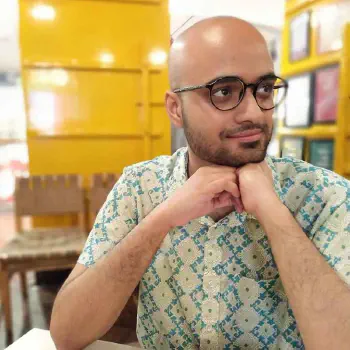
Dhritiman (He/Him) is a 31 year old mental health therapist from Delhi. They practice online. They identify as 🌈 Queer.
I guess several reasons converged and something deep resonated with me in this profession. First, I know how lonely and dreadful it is to go through mental health struggles alone even if you have people around you. Being able to provide a safe space to both distressing emotions and the yearning for growth and healing is intensely rewarding. Second, after trying out my hand at a desk job, I knew that I could never do that. I wanted meaning from my work and a sense of connection both in the individualistic space of one therapy session and in the larger society where most people are suffering in silence. Third, without meaning to, I just discovered that I was actually good at it. :)
The unique depth that every person has as an individual. Being able to give voice to things that are silenced in all aspects of our society. Being able to witness the powerful human desire to heal and make meaning. Also, being able to actually see the surprising and unexpected ways our unconscious works – especially as a part of us that wants to protect us, and as a creative force. Lastly, the deep and intimate nature of the therapeutic connection is something that is always touching. It is neither personal nor impersonal but something in-between that truly makes it a safe and authentic space.
The feeling of being heard and seen. The feeling that what they are experiencing is real and can be put into words. The feeling of being understood. The feeling that they are not alone. The feeling that their distress is a part of what they feel and there are several other parts of their self as well. The feeling of being safe while being able to be vulnerable in whatever way they see fit.
First of all, it is great that you are thinking about your mental health in a society that would often prefer that someone suffers for life rather than talk about difficult or taboo experiences. Second, counselling is a partnership where the assumption is that you are the expert of your own life. I would not be able to make decisions for you or even give you advice (unlike a doctor). And there are rarely any quick fixes. My role is to accompany you in your journey of self-exploration and use my technical and experiential knowledge to participate in a dialogue with you regarding your healing. Third, counselling is your space. You can talk about anything you like and feel comfortable with. And, it’s always great to get honest feedback from my clients, especially when something is missing or not going that well.
A participatory relationship where the client’s needs direct the course of the therapeutic journey. My aim is to always make the client feel safe enough to be able to explore things that are threatening to them or others.
It is impossible to choose one thing so here’s an incomplete list: 1) That we all have multiple parts, some conscious and some not so much, and they all play their unique and often conflicting roles in keeping us safe, helping us grow, and being creative. Our self can surprise us precisely when we think we have figured ourselves out fully. 2) Guilt and shame are mind killers. They are often at the core of psychological suffering. More often than not, they are unjustified and either come from social narratives. Sometimes it is also our way to ward off some things that are more painful than self-blame. 3) Positive emotions often accompany negative ones instead of negating them. Love and hate can co-exist. Our cultural emphasis on mental health as being a process where you just force yourself to be happy is harmful and mutilates many, many parts of our mind and often makes people more miserable.
Read a LOT. I am a textual omnivore and I like reading many different things from different fields at once. Usually I read a psychology book, a history or non-fiction books, and a fiction book. I would like to write more. I watch Netflix and YouTube as well. Like gaming.
I use multiple techniques and schools of therapy. I first figure out the needs of the clients which gives me an idea about the problems they are facing and the aims of therapy. Based on that I plan the counselling process. My stance with my clients is humanistic i.e. it is respectful, sees them as equal partners in the process, is validating and empathising. I use techniques from Cognitive behavioural therapy, Solutions-focused therapy, trauma-focused therapy, Narrative therapy, and Rogerian Counselling. In terms of thinking about the case, or conceptualizing it, I refer to psychodynamic theories that talk about relationships, attachments, and multiple conscious and unconscious parts of us interacting and creating a psychological structure. However, since I am not trained in it, I don’t use psychodynamic techniques per se.
I ask every client how they would like to be addressed. I don’t force them to talk about their queerness unless they feel safe enough to talk about it. There are no taboos or stigmas around any topic relating to queerness in my practice. I have also been a part of many queer spaces. For instance, I was a Safe Access Fellow and I helped build a directory of queer-friendly health practitioners in Delhi/NCR.
It is a joy to be hidden and a disaster not to be found.
Hit the button below, ask questions, clear doubts or anything else you might need to clarify. You’ve got this! 🙂
Learn about their approach, specialties, and how they can support your mental health journey.
Take the first step by reaching out and start a conversation about your needs.
Determine if this is the right match for you and plan your journey forward.
Not finding what you're looking for?
View other profilesWhile we carefully curate our listings, we encourage you to make your own informed decisions. Take time to research, ask questions, verify credentials and choose what feels right for you. Your comfort and safety is top priority.
We've developed a curation process over 7+ years, which allows us to carefully curate each inclusive and affirming mental health provider listed on our platform.
We have come a long way since we started in 2018, and have been adapting our curation process every day. From the time a therapist or support group reaches out to us, it takes about 1 - 2 months to complete the process.
We launched TheMindClan.com because we know firsthand how challenging it can be to find support for ourselves and our loved ones. We know that experiences of neurodivergence (like dyslexia, ADHD, autism, etc), or being from a marginalized community (LGBTQIA+, etc), can make it especially challenging to find support.
We understand the overwhelming feeling of scrolling through endless lists, wondering whom to trust, and not knowing what to expect.
If you appreciate our mission of making mental health care accessible and inclusive, and would love to bring this to your organization or collaborate with us, we'd be delighted to hear from you!