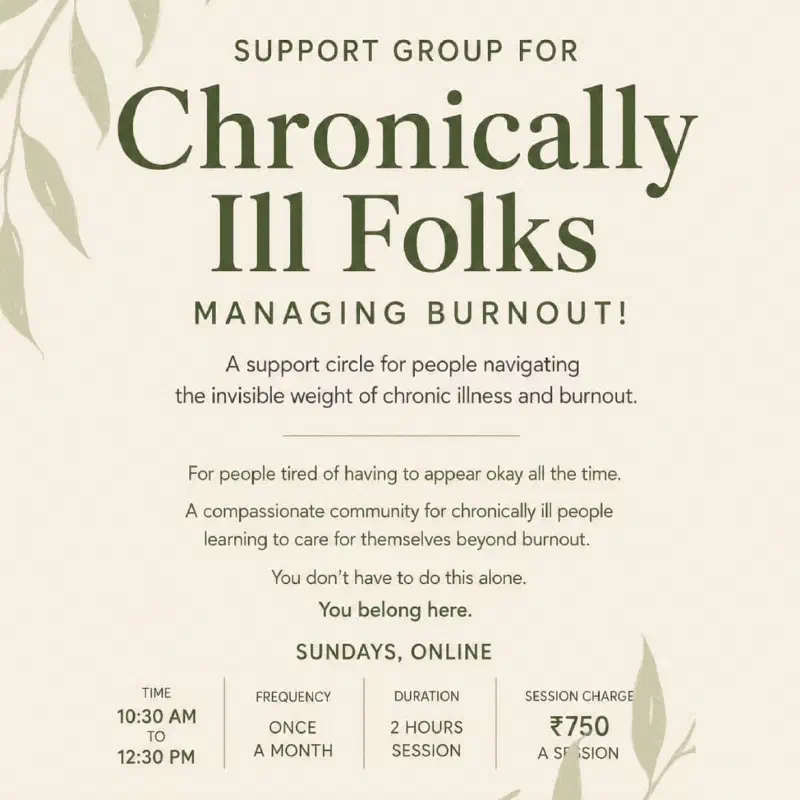
Type: Support Group, Sharing Space :
Support Group for Folks with Chronic Illness Picture

Support Group for Folks with Chronic Illness

Fee ₹ 750
Next Step Request To Join
Medium Online
Frequency Every third Sunday of the month

People who have been diagnosed with a chronic illness- diabetes, high blood pressure, kidney/liver/organ issues, autoimmune conditions/progessive neurologic conditions

FAQ
  • Who is this support group for?


    You may clarify the above details with them directly. Get to know them 👇

Replies in 48 Working Hours.Direct Sign Up Form Available.

Key Details

Languages
English and Hindi (English might be the primary language for this group)
Facilitated By
A Mental Health Professional
Fee Type
Paid
Organized By
The Community
This meetup is part of our handpicked list of communities 🤗
We've been working since 2018, to curate inclusive spaces for anyone to access when they're in distress.
Carefully curated Community-led Reach out directly. No Gatekeeping.

When you reach out to a community, our platform gets you directly in touch with them. No gatekeeping, no extra charges or middleman. This might make the process of hearing back from them take a bit longer, but that's our way of ensuring you stay in control of your mental health journey.

  • What Is Support Group for Folks with Chronic Illness About?

    The support group is for people with chronic illness and the difficulties, both emotional and social that comes with managing a chronic illness. It is for the members to come together and share their experience of living in a body that works differently, what it means to occupy a space where “health” looks very different, and it comes with different consequences. It is a space for people to come together, share, laugh, cry, find comfort by either voicing, or being a silent witness to other’s stories with similar experience.

  • What is your founding story?

    One of the facilitator is a patient of chronic kidney disease, and they have undergone a kidney transplant at a young age. They often felt that within the chronic illness community there was not much space for any complaints, everyone always had to either be resilient or brave. They wanted to bring forth another aspect of chronic illness to life - the burnout, the exhaustion, the not-so-good days. They believe that when a person’s pain is witnessed and shared by others, that contributed to mental well-being. Their own experience of being part of similar groups often left them feeling more ( even when they felt reassured that folks like them exists). The need arises from this same feeling of creating a space where one can meet their experience of being ill as it is, and not how it should be, and receiving care and support without the performance of resilience. The hope is for folks to come together and collectively create a space where support, care and sharing allows one to rest, be kinder on themselves and de-construct ideas of “health”, being a reproductive person and offer different perspectives.

  • Who are the facilitators behind Support Group for Folks with Chronic Illness?

    I’m Shipra Parswani (she/her), a psychotherapist who specializes in a trauma-informed approach to healing. My practice is eclectic, meaning I blend various techniques from different therapeutic schools to best suit your needs and comfort. My approach is centered on you—together, we’ll determine the most effective path forward, ensuring the process feels natural and comfortable for you. In addition to this, I incorporate a body-based approach. I believe the mind and body are interconnected, and exploring how our physical sensations relate to our emotions is key to deeper healing. Overall, I incorporate trauma-informed and queer affirmatives.

    Drawing from modalities such as somatic therapy, parts work, inner child healing, and other trauma and body-focused techniques, I aim to help you build a stronger connection between your body and emotions. I am trained in Integral Somatic Practice (ISP), Eye Movement Desensitization and Reprocessing (EMDR), and the treatment of complex trauma, all of which allow me to provide a personalized and holistic approach to your therapy.


    Notes: The above information may change from time to time, and is shared with you to understand the background of where the support group comes from.
  • When was your support group founded? How has the journey been since then?

    The group was founded in the second half of 2026, our first meet was in July. We have met twice by now and the group keeps on growing. Folks have come in with differing perspectives and we have opened up space for many conversations. The intention is here is for the person to experience themselves as part of the larger group of people going through an illness, finding out different ways of surviving/thriving, adapting to each other, being influenced by each other. Hoping that thr group turns into a community where people can physically meet, rely on one other, be comfortable asking for people and support. In the future, the wish is that this turns into a network of support and folks with chronic illness can be equipped to offer correct support to themselves and others.

  • Who is your support group for?

    People who have been diagnosed with a chronic illness- diabetes, high blood pressure, kidney/liver/organ issues, autoimmune conditions/progessive neurologic conditions

  • Explain your group's approach towards helping a person's mental health care.

    Our group takes a holistic, empathetic approach to mental health care for people living with chronic illness. We recognise that emotional distress can be closely connected to the realities of living with a long-term condition, including uncertainty, treatment fatigue, changes in identity, relationships, work, and everyday life. The group provides a non-judgmental space to share experiences, process difficult emotions, and learn from others who understand similar challenges. We focus on building coping skills, self-compassion, resilience, and a sense of connection rather than expecting participants to simply “stay positive.” A key nuance is that we validate that difficult emotions are a natural response to chronic illness and do not treat them as personal failures. The group also respects that every person’s illness journey is different, allowing members to participate at their own pace and in ways that feel comfortable to them.

  • What is your group's approach towards professional mental health care interventions?

    We are clear in our vision that the group exists as a part of larger support system that a person with illness may require. We do not aim to replace the role of therapists/psychiatrist, infact we encourage reaching out to them. We have a team of therapists that the participants may choose start therapy with, we also have a trained primary responder at our support group. We share resources/list of MHPs they may reach out to for long term therapeutic support.

  • What conversations is your support group not equipped to support?

    Group isn’t equipped to support - family issues, marital issues, suicide, self harm, decisions making around terminal illness, grief around terminal illness, any monetary challenge. We area of concern is support for folks with chronic illness, managing and preventing burnout, fostering conversations within the space, allowing of emotions and building emotional safety around experiences.

  • How does one sign up? What's the coordination process like?

    1. Fill the google form
    2. Make the payment ( the payment details are provided in the google form itself)
    3. They will receive the google meet link and confirmation of the dates.

    The process is coordinated by the facilitator

    Request To Join
  • Walk us through the average format of your group session.

    The group begins with a short grounding exercise. It can either be taking three breaths, or looking around. The choice is of the participants. This is follwed by a 5-10 mins explanation of rules, intentions, hope and overview of the support group. This follows a round of introduction where they can share something about themselves/their work/their illness. Followed by few prompts used by facilitator if required, if the flow of group is good, facilitator takes a backseat. The purpose of the prompts is to set the intention- intentions being experiencing what it means to have a chronic illness, what aspect of it are you carrying within yourself, what would you like to share, etc. Towards the end, a small activity is done, usually to bring closure for the emotions/feelings that have come up. Last few meetings it was writing a letter, or imagining offering support to a younger version of yourself, or drawing out what burnout/connection looks like.

  • What are your home rules/values?

    Rules

    1. No medical advice is offered, everyone is allowed to make a choice with regards to their illness.
    2. No judgements on anyone’s way of dealing with their illness
    3. Confidentiality - no one’s experienced is shared outside
    4. Strictly no contact outside unless both participants verbally consent
    5. Meeting people where they are, which means coming in with curiosity and empathy regarding their condition
    6. Avoiding directly asking what illness the other person has/respecting their right to not share details of their illness
    7. No religious statements to be passed
    8. Respecting sexuality/gender, respecting pronoun. Failure to do that may result in asking facilitator to ask the participant to step outside
    9. Offering support/sharing similar experience after asking consent of the participant who shared, a simple " Hey, this brings something up for me. Is it okay if I share?"
  • What do you hope for participants in your group to take back with them after a session?

    The hope is for the group to facilitate greater acceptance and compassion within the participants towards themselves and others, for them to understand and see that they are not the only ones. For them to identify areas of their lives where support has/had been missing, and find courage to ask for that support starting from the group itself.

    For them to have a better understanding of what a chronic illness is, what it does and what it doesn’t do, that life is not over if one has a chronic illness. Further, for the participants to develop a wellness oriented perspective where they can take care of their health not owing to pressure of family, guilt or fear, but rather from their own value system, from a place that makes them want to continue showing up for themselves. It also hopes to be a space where people understand that there is not a perfect way to take care of illness, all we can do is try to be as efficient as possible. It is also for them to identify if they require more long term mental health help and feel okay to do so.

Ready To Reach Out To ?

Hit the button below, ask questions, clear doubts or anything else you might need to clarify. Sign up soon! You’ve got this! 🙂

Next Steps For You

How To Seek Support From This Group

1. Discover more about this gathering

Learn about the gathering's approach, specialties, and how they can support your mental health journey.

2. Reach Out To The Organizer

Take the first step by reaching out to 'Support Group for Folks with Chronic Illness' and start a conversation about your needs.

3. Gauge value fit, and take next steps

Determine if this is the right match for you and plan your journey forward.

Not finding what you're looking for?

View other events & support groups

While we carefully curate our listings, we encourage you to make your own informed decisions. Take time to research, ask questions, verify credentials and choose what feels right for you. Your comfort and safety is top priority.
